







Facebook is a terrible focus group. Anger can win elections. Effective governing requires results, restraint, judgment, organization.
Shared with approval.
Leadership Institute Advanced School of Politics
Leadership Institute Advanced School of Politics
The Advanced School of Politics | Published Aug 28, 2026
Electoral victories disappear when activists confuse outrage with governance.
(JA: This example from FL applies everywhere
and not only to school boards!)
and not only to school boards!)
A 2-to-1 registration advantage should buy a political party some margin for error. Sarasota Republicans managed to squander it all.
As of July 31, Sarasota County had 163,131 registered Republicans and 80,692 Democrats.
Yet on August 18, Republican-endorsed school board candidates lost two seats by double digits.
They should have seen it coming.
Two years earlier, the conservative school board chair lost to a first-time candidate in the same heavily Republican county. Voters had already sent a warning message, but it was apparently marked as spam.
As of July 31, Sarasota County had 163,131 registered Republicans and 80,692 Democrats.
Yet on August 18, Republican-endorsed school board candidates lost two seats by double digits.
They should have seen it coming.
Two years earlier, the conservative school board chair lost to a first-time candidate in the same heavily Republican county. Voters had already sent a warning message, but it was apparently marked as spam.
Winning and Governing Require Different Skills
Winning a school board majority and sustaining it requires different political skills. Anger can win an election. Governing requires results, restraint, judgment, and organization.
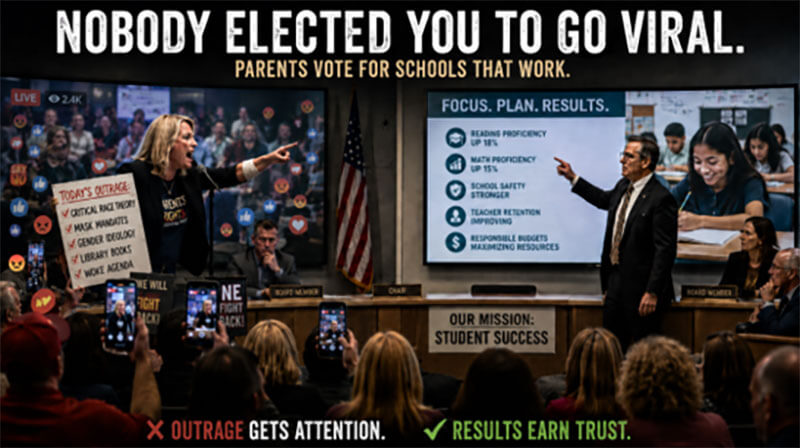
Conservatives swept into school board races after COVID closures, mask fights, curriculum disputes, and parental frustration created a powerful political opening.
Many of the gains were deserved. Parents had legitimate complaints, school bureaucracies had become arrogant, and too many boards had forgotten who employed whom.
Many of the newly elected conservatives then made a rookie mistake.
They continued campaigning from the dais.
Every meeting became another circus of combat. Every national controversy became a local purity-test resolution. Every Facebook fight demanded action. Every activist with a smartphone became an unofficial political adviser.
Every meeting became another circus of combat. Every national controversy became a local purity-test resolution. Every Facebook fight demanded action. Every activist with a smartphone became an unofficial political adviser.
Facebook is a terrible focus group.
It rewards the sentence that excites your followers, not the one that reassures skeptical parents (AKA voters).
Constant affirmation convinces inexperienced politicians they are invincible right up until voters prove otherwise.
A cable-news hit can build a personal brand, but it cannot do your job.
Constant affirmation convinces inexperienced politicians they are invincible right up until voters prove otherwise.
A cable-news hit can build a personal brand, but it cannot do your job.
Suburban Parents Are Risk Managers
School board politics carries a particular burden in suburban communities. Parents may hold strong views on curriculum, parental rights, student privacy, discipline, gender policy, library materials, and dozens of other issues. These issues deserve serious consideration.
Parents also care about whether Johnny can read, solve math problems, and know whether Au is the chemical symbol for gold or for silver.
They care about test scores, school safety, teacher quality, on-time bus arrivals, classroom discipline, college preparation, vocational programs, and budget responsibility.
The side that voters perceive as obsessed with political theater eventually creates an opening for the other side to claim the mantle of normalcy.
Sarasota was not unique.
Different districts. Same warning.
Voters will tolerate policy disagreement, but they grow tired of chaos.
In 2023, Democrats swept all five contested seats in Pennsylvania’s Central Bucks School District, flipping the 6-3 Republican board to a 6-3 Democratic board after years of nationally publicized fights. Conservative majorities also fell in nearby Pennridge and Perkiomen Valley. (And in Texas) High-profile conservative school board candidates faced similar setbacks in Iowa and Virginia.
Understand the Job You Won
Here is the part too many new board members miss: school board members do not run schools day to day. (JA: This does not mean conservatives surrender their principles and campaign promises to the Superintendent. Instead, they should put their values into action with effective policies and hard work– not just yapping about it! You can’t beat “something” with “nothing.”)
Hire an excellent superintendent who understands the board’s priorities. Establish clear, lawful policies. Set measurable academic goals. Demand accountability. Monitor performance. Replace those who fail to deliver.
When the law requires a public board vote, take the vote and defend it.
When it does not, stop manufacturing symbolic roll-call ceremonies for national cable news.
A board resolution condemning the latest national outrage may earn applause tonight, but a board-backed superintendent who raises reading proficiency will still matter in four years.
Outrage draws short-term attention. Parents reward long-term results.
In Sarasota, the board sets policy, appoints the superintendent, and oversees the district. The superintendent leads the district's daily academic and operational strategy. That structure should guide conservative board members in how to govern.
Learn From the Opposition
Teachers’ unions did not become powerful by failing to understand what control of school boards means for their budgets. Watch how union-backed candidates campaign. They talk about students, classrooms, teacher retention, academic achievement, stability, resources, and safety. They speak to parents’ concerns because they know how to win.
A school board majority requires maintenance. (JA: The same holds true for any conservative majority on any governing body at any level of government.)
Build a Majority
Every controversial policy should answer a simple question that voters can understand: How will this help students learn? (JA: City Councils & Commissioners Courts: How will this help us deliver better services and better manage taxpayer dollars?)
Conservatives should own that ground.
Conservatives may strongly disagree with what those candidates will later support. Fine. Hold them accountable for their voting records.
But learn the communications lesson.
The teachers’ unions understand that swing voters rarely walk into a school board election hoping to referee someone else’s ideological cage match. They want assurance that their children will receive an excellent education.
Parental rights should connect to better education. Curriculum transparency should connect to academic quality. Discipline should connect to safe classrooms. Fiscal responsibility should mean directing more resources to where they improve student performance, which means investing in well-paid, good teachers, not in more bad administrators.
Four rules help:
1. Measure achievement. Select a small number of academic and operational outcomes, publish them, and relentlessly report progress.
2. Govern through competent administration. Hire well, set direction, supervise, and hold the superintendent accountable.
3. Make competence visible. Talk constantly and consistently about student outcomes, classroom order, teacher quality, safety, fiscal stewardship, and preparation for life after graduation.
4. Maintain the political organization. Recruit candidates, cultivate parent leaders, build local validators, organize precincts, communicate with persuadable voters, and never assume that party registration will do the work for you.
A 2-to-1 Republican registration advantage is an asset. It is not a guarantee.
The side that voters believe puts students (citizens) first holds the strategic high ground over time.
Political philosophy matters.
Policy matters.
Parental authority matters. But none of those goals survive when voters conclude that the people advancing them enjoy the fight more than they want to govern.
The loudest board member may earn an invitation into the cable-news echo chamber. The board member who improves the schools earns something far more valuable: permission to keep governing.
Political influencers love chaos.
Parents (and taxpayers) love a school (commissioners court or city council) that works.
Nobody elected you to go viral. Govern wisely.
The side that voters believe puts students (citizens) first holds the strategic high ground over time.
Political philosophy matters.
Policy matters.
Parental authority matters. But none of those goals survive when voters conclude that the people advancing them enjoy the fight more than they want to govern.
The loudest board member may earn an invitation into the cable-news echo chamber. The board member who improves the schools earns something far more valuable: permission to keep governing.
Political influencers love chaos.
Parents (and taxpayers) love a school (commissioners court or city council) that works.
Nobody elected you to go viral. Govern wisely.
War Room Texas: Interface Editor Note: GAWTP and Leadership Institute Advanced School of Politics | September 1, 2026

MAN AND WOMAN
FOR THE WORKING
Texas
Nobody Elected You to Go Viral
just cuz it ain't here
don't mean we don't care
If you don't see yo topic,